
Sunday, January 4, 2015
Moved!
As you may have noticed, we are no longer posting regularly on this blog. But don't worry! We have a new, much more ambitious project that has just begun. Follow along as we attempt to eat only food produced on our own farm. We'll be posting four times per week, and we'll try to keep things varied and interesting by using our own silly experiment as a platform to explore topics of agriculture, society and turnips. www.cairncrestfarm.com/blog/


Tuesday, October 7, 2014
Cowspiracy Movie Review
We no longer blog here. Because of the increased discussion around this review, I have reposted it over on my current blog. I'm happy to have a civil discussion with anyone there.
As I set out to write about the documentary Cowspiracy, two problems are obvious. The first is that, as someone who raises cows and sells their meat, I am not by any stretch objective. The second is that it’s called Cowspiracy, which makes me want to think of all the dumb cow-related puns I can (Cowspiracy is a moo-vie that makes beefy claims about a subject I have a steak in, etc.), and then to make a cup of tea while I think of more dumb cow-related puns (the film employs no hoof measures in its stampede to a reductive conclusion, and it repeatedly milks the same points in an effort to steer the conversation away from any topic that would actually encourage viewers to ruminate).
Like most people, I have a kneejerk conviction that things I believe are right for the simple reason that I believe them. When I look out my window and see the herd of cows I just moved grazing a fresh break of pasture after having someone announce over social media that my raising them is some sort of ecological catastrophe, I want to get mildly incensed, knock down a few straw men in my mind, and then dismiss it to go about my day with an extra lift in my step. But, I tell myself, it’s good to make an effort, however compromised, at critical examination of topics I have strong feelings on.
Also, other than the whole dismissal of raising any livestock thing, I agree with some critiques of the sort made in Cowspiracy. What people choose to eat does have an impact on what kind of farming is done, and some types of farming are worse for land and animals than others. All of the various organizations that advise people on how to use less water or emit less greenhouse gases or destroy less jungle are being silly or disingenuous - or cowspiratorial - if they don’t discuss the roles food choice and the resulting agricultural practices play in various environmental issues.
The difficulty in discussing these or any other topics raised by Cowspiracy is that, though it certainly takes strong stances on both, it is neither fish nor fowl. It’s at once an investigative documentary, a personal journey, and most of all an argument for a vegan lifestyle. While the film does try to make good on its title by suggesting (though not nearly proving) that prominent environmental organizations are beholden to the livestock industry, it also takes time to dismiss the possibility of responsibly harvesting any fish, to visit a backyard duck farm, to liberate a chicken, and to establish that vegan diets are healthy, all while following filmmaker/protagonist/narrator Kip Anderson’s not entirely convincing arc from concerned but uninformed citizen to empowered herbivore. Responding to a polemic that plays as fast and loose with facts as this film could easily devolve into a line by line response, which would be even more boring to read than it would be to write. Instead, I’ll focus on a few of the main topics, beginning with how cows drink, burp, fart, and most of all poop, which - not to brag - I have some experience with.
The drought that has scorched California for going on three years now makes water use an understandable priority for Anderson, since it is where the film is set and presumably where he lives. So when he finds that it takes 2,500 gallons of water to produce a single pound of beef, he is chagrined. Unfortunately, he does not explain how he arrives at this number either in the film or on the film’s website. It strikes me as a bit high, so let’s see if we can figure out where all that water goes. Assuming a steer drinks on average 1.5 gallons of water per hundred weight daily, and supposing the steer is born at 50 pounds and slaughtered at 950 after two years of steady growth to yield 350 pounds of saleable meat, his average weight would be a little more than 450 pounds over the course of his life. Putting all these numbers together gives us expected direct consumption of about 5000 gallons of water. This is at best an approximation, since growth rate is variable, water consumption depends both on the ambient temperature and the water content of forage consumed, and we actually raise our cows to 27 months. Also, for the sake of fairness, a share of the water the steer’s mother drinks during his first year should be considered in the cost of raising him. Even if we assume my numbers above are low on every count and double his lifetime consumption to 10,000 gallons, it’s safe to say some water needs to be accounted for if we’re going to get to the number quoted by Anderson, since 2,500 gallons per saleable pound would lead us to expect a lifetime consumption of 875,000 gallons, a mere 865,000 more than our high estimate.
This raises the idea of embedded water - that a cow somehow uses all the water required to raise its feed. If I do more boring math I can actually get in the neighborhood of the larger number by counting all the water that falls in the growing season on the grass that the steer eats. An acre inch of rain is about 27,000 gallons, and we generally get a decent amount. But pretending that a cow munching away on perennial pasture somehow disrupts the natural water cycle such that we need to call this a cost of production is self-evidently absurd. No water is destroyed in the making of a cow, and rain falls and grass grows whether there’s a herd there to eat it or not. However, this measure becomes meaningful in a place like California, where huge amounts of forage are grown for beef and dairy on irrigated pasture. I am still skeptical of the 2,500 gallons per pound number, but I agree that raising alfalfa on irrigated land in the desert is horrifically short-sighted. Anderson interviews Manucher Alemi and Kamyar Guivetchi at the California Department of Water Resources, and when they uncomfortably dance around why they don’t recommend reducing meat consumption, he sees a conspiracy of silence; I see state employees who don’t want to be caught on film telling Californians that they can help the drought by buying meat and cheese produced in less arid parts of the country or by finding California producers who rely on precipitation rather than irrigation to grow forage.
Methane is a more vexed question, since cows indisputably belch and fart. In the film Anderson implies that cows are the main source of methane and that reducing their numbers is the fastest way to reverse global warming. After too much time poking around in search of definitive numbers on methane emissions, I decided to use those provided on a NASA website, even though a number of reputable sources arrive at different conclusions, particularly concerning the amount of methane released by wetlands, listed at 22% in the data I am quoting. By these numbers, ruminant livestock directly account for 16% of global methane emissions, and the (mis)management of all livestock manure accounts for another 5%. Human sewage treatment is 5%, biomass burning is 8%, fossil fuels production is 19%, and, surprisingly, rice cultivation is 12%. Various other manmade and natural sources fill out the remainder. While 21% of total methane is certainly significant, the idea that the elimination of livestock would clearly lead to a reversal of global warming trends is both an overstatement and an oversimplification, without getting into matters of methane’s half-life relative to carbon’s.
Here’s another way to look at it. There are about 88 million beef cows in America and just over 9 million dairy cows. In 1800 there were 60 million buffalo, and though the film claims that grassfed beef is more damaging than feedlot beef, I’m confident those buffalo weren’t routinely wandering into CAFOs in an effort to reduce their methane emissions. But I doubt Anderson would accept a target of 60 million grassfed cows as ecologically sustainable, even though keeping them on pasture, besides making them healthier and happier, would mostly eliminate the 5% of methane emission that are a result of manure fermenting in lagoons and piles.
The film fails to address, misrepresents, or glosses over any number of interesting points. At the backyard duck farm Anderson does some math and decides that it has a 100 to 1 feed to meat ratio, which is so obviously impossible that it suggests he simply doesn’t consider the roughly 500 eggs the duck likely produced during its life to be food. He says that 45% of the earth’s land is used for livestock production, even though the best information I can find puts the global total at about 40% for all agriculture. He dismisses any discussion of Allan Savory’s claims about managed grazing both improving degraded land and sequestering carbon by getting off a pithy line about the silliness of using livestock to reverse damage caused by livestock and an expression of horror at the range management practices Savory endorsed in the 1950’s. He doesn’t acknowledge that Savory himself is outspoken about the mistakes he made as a younger man and that in part due to them he now advises land managers to constantly evaluate every practice against its eventual goal. He’s outraged that the BLM rounds up wild horses and burros to make way for cattle, despite the fact that all three are European imports. He blames livestock production for the continued existence of hunger but doesn’t discuss the surplus of calories already produced or the systemic factors that prevent food from going where it is most needed.
But, at least to my mind, he shows the least nuance when discussing poop. He tells us that 16,000 pounds of manure are produced every second in the U.S., enough to cover a number of major cities as well as several states, a statistic that I would find more interesting if he mentioned the depth of the coating. Later he says livestock produce 130 times the excrement of humans, without the benefit of waste treatment. He implies that his revulsion at this is natural and correct, which makes me feel a little weird, since one of my goals is to have an even layer of poop spread over my pasture land every grazing season. Historically, animal manure has been recognized as the very best fertilizer, and many of the early efforts to improve rather than degrade land both in America and England revolved around managing it. Manure only becomes a problem rather than something to celebrate when it piles up unused outside of factory pig and chicken operations or stews in anaerobic lagoons. When an appropriate number of animals are kept on an appropriate amount of land and managed with attention to both, their activities - there feet and hooves, their grazing, pecking, scratching and rooting, and most of all their manure - sustain, renew and even improve the ground that feeds them.
The great weakness of Cowspiracy, other than its title, is its single minded determination to prove that veganism is the only reasonable approach to feeding people, a proof it pursues without regard for facts or nuance. That’s not to say it’s worthless, for there are ideas for several good films within it. I would love to watch a truly investigative examination of any links between the industrial agriculture sector and large environmental non-profits, rather than one that infers connections from the vague responses of uncomfortable PR people. A devastating documentary could be made about the insanity of beef and dairy production in California, and I am all for consumers voting against them and other parts of the industrial food system with their dietary choices. I even think a fair examination of the ways small farms are not inherently better for land and livestock would be wonderful. Instead of any of these there is a failed effort to prove that one lifestyle choice can solve every environmental and agricultural problem.
This failure is not just a result of misleading and erroneous data, but even more so of superficiality. Though I watched carefully and took copious notes, I do not have a clear idea what Anderson’s vegan world would look like. Would excess land be converted to wilderness? Should the hills and fields of my farm return to forest and scrub like so much of the nearby land that used to be grass? Why is a monoculture of wheat preferable to a polyculture of pasture? Should we humans be connected to and reliant on the land around us and should these connections take different forms in response to local conditions? Yesterday, while out hunting turkey, I came across the remains of a deer, one of ten or so my brother and I have found this year. All of them starved or froze to death in the clutches of last winter. Now they are piles of mossy bones marking where living things curled up and never stood again. Why is this preferable to raising cows as I do, particularly when there’s room here for both?
I am willing to say that true wilderness and unmanaged land have intrinsic value. I think of the sense of awe a still forest raises in me or the way a rough-legged hawk hanging in the air on a stark, white morning pushes all thought from my mind, and I know that the trees and birds and animals going about their lives have value even when I am in no way the beneficiary of them. I recognize that this claim is metaphysical rather than utilitarian, and it is critical to how I understand my role in the world, because I think farmed land shares this inherent worth. To borrow a thought from Wendell Berry, the land stretching out from the Adirondacks is deserving of the same reverence as the mountains themselves. The destructiveness of so many modern agricultural practices rests on a view of livestock as exclusively means to an end, rather than as beings in a world, intricate beyond our comprehension, to which we also belong.
I have a difficult time articulating this view, and I doubt I could make a good documentary about it, particularly since even made up statistics don’t have much to say about such matters. But to be meaningful, any discussion of agriculture and eating needs to engage with questions of our values and the specific forms those values should take. Cowspiracy provides a facile solution, dressed up with shoddy numbers, and in its effort to push a predetermined agenda it doesn’t begin to answer the questions a person should ask when deciding what to eat.
Here’s another way to look at it. There are about 88 million beef cows in America and just over 9 million dairy cows. In 1800 there were 60 million buffalo, and though the film claims that grassfed beef is more damaging than feedlot beef, I’m confident those buffalo weren’t routinely wandering into CAFOs in an effort to reduce their methane emissions. But I doubt Anderson would accept a target of 60 million grassfed cows as ecologically sustainable, even though keeping them on pasture, besides making them healthier and happier, would mostly eliminate the 5% of methane emission that are a result of manure fermenting in lagoons and piles.
The film fails to address, misrepresents, or glosses over any number of interesting points. At the backyard duck farm Anderson does some math and decides that it has a 100 to 1 feed to meat ratio, which is so obviously impossible that it suggests he simply doesn’t consider the roughly 500 eggs the duck likely produced during its life to be food. He says that 45% of the earth’s land is used for livestock production, even though the best information I can find puts the global total at about 40% for all agriculture. He dismisses any discussion of Allan Savory’s claims about managed grazing both improving degraded land and sequestering carbon by getting off a pithy line about the silliness of using livestock to reverse damage caused by livestock and an expression of horror at the range management practices Savory endorsed in the 1950’s. He doesn’t acknowledge that Savory himself is outspoken about the mistakes he made as a younger man and that in part due to them he now advises land managers to constantly evaluate every practice against its eventual goal. He’s outraged that the BLM rounds up wild horses and burros to make way for cattle, despite the fact that all three are European imports. He blames livestock production for the continued existence of hunger but doesn’t discuss the surplus of calories already produced or the systemic factors that prevent food from going where it is most needed.
But, at least to my mind, he shows the least nuance when discussing poop. He tells us that 16,000 pounds of manure are produced every second in the U.S., enough to cover a number of major cities as well as several states, a statistic that I would find more interesting if he mentioned the depth of the coating. Later he says livestock produce 130 times the excrement of humans, without the benefit of waste treatment. He implies that his revulsion at this is natural and correct, which makes me feel a little weird, since one of my goals is to have an even layer of poop spread over my pasture land every grazing season. Historically, animal manure has been recognized as the very best fertilizer, and many of the early efforts to improve rather than degrade land both in America and England revolved around managing it. Manure only becomes a problem rather than something to celebrate when it piles up unused outside of factory pig and chicken operations or stews in anaerobic lagoons. When an appropriate number of animals are kept on an appropriate amount of land and managed with attention to both, their activities - there feet and hooves, their grazing, pecking, scratching and rooting, and most of all their manure - sustain, renew and even improve the ground that feeds them.
The great weakness of Cowspiracy, other than its title, is its single minded determination to prove that veganism is the only reasonable approach to feeding people, a proof it pursues without regard for facts or nuance. That’s not to say it’s worthless, for there are ideas for several good films within it. I would love to watch a truly investigative examination of any links between the industrial agriculture sector and large environmental non-profits, rather than one that infers connections from the vague responses of uncomfortable PR people. A devastating documentary could be made about the insanity of beef and dairy production in California, and I am all for consumers voting against them and other parts of the industrial food system with their dietary choices. I even think a fair examination of the ways small farms are not inherently better for land and livestock would be wonderful. Instead of any of these there is a failed effort to prove that one lifestyle choice can solve every environmental and agricultural problem.
This failure is not just a result of misleading and erroneous data, but even more so of superficiality. Though I watched carefully and took copious notes, I do not have a clear idea what Anderson’s vegan world would look like. Would excess land be converted to wilderness? Should the hills and fields of my farm return to forest and scrub like so much of the nearby land that used to be grass? Why is a monoculture of wheat preferable to a polyculture of pasture? Should we humans be connected to and reliant on the land around us and should these connections take different forms in response to local conditions? Yesterday, while out hunting turkey, I came across the remains of a deer, one of ten or so my brother and I have found this year. All of them starved or froze to death in the clutches of last winter. Now they are piles of mossy bones marking where living things curled up and never stood again. Why is this preferable to raising cows as I do, particularly when there’s room here for both?
I am willing to say that true wilderness and unmanaged land have intrinsic value. I think of the sense of awe a still forest raises in me or the way a rough-legged hawk hanging in the air on a stark, white morning pushes all thought from my mind, and I know that the trees and birds and animals going about their lives have value even when I am in no way the beneficiary of them. I recognize that this claim is metaphysical rather than utilitarian, and it is critical to how I understand my role in the world, because I think farmed land shares this inherent worth. To borrow a thought from Wendell Berry, the land stretching out from the Adirondacks is deserving of the same reverence as the mountains themselves. The destructiveness of so many modern agricultural practices rests on a view of livestock as exclusively means to an end, rather than as beings in a world, intricate beyond our comprehension, to which we also belong.
I have a difficult time articulating this view, and I doubt I could make a good documentary about it, particularly since even made up statistics don’t have much to say about such matters. But to be meaningful, any discussion of agriculture and eating needs to engage with questions of our values and the specific forms those values should take. Cowspiracy provides a facile solution, dressed up with shoddy numbers, and in its effort to push a predetermined agenda it doesn’t begin to answer the questions a person should ask when deciding what to eat.
-Garth
As a final note to anyone interested in a comprehensive treatment of all these and other matters, the book Meat: A Benign Extravagance by Simon Fairlie is incredible. Don’t let the dippy cover fool you. As an even final-er final note, I’ll mention that he indirectly gives a detailed answer to Anderson’s closing question to Michael Pollan about how much meat and dairy per person a truly sustainable agricultural system could provide. Fairlie arrives at just over 83 pounds of total meat each year, with dairy consumption at current levels. This is for the UK, and with the lower population to arable land ratio in America, they would likely be a bit higher here.
Monday, October 6, 2014
Summer's Old News
This is a blog post I wrote months ago and never hit 'publish' on. Oh summer. How you overwhelm me. Here is the updated version of yesterday's news.
Edmund and Garth devoted a lot of time this summer to prepping the North half of our flat land for a fence. They spent weeks thinning this tree line and dealing with the abundance of wood and roughage that resulted.


The Soil and Water folks in our county have a post pounder they rent out at a price well below all of their competitors that we took advantage of. The engine stopped 5 minutes into the project, but two guys from their office came out and fixed it within an hour of our call. What service!

Aside from fencing the flats, we have taken on a new species - pigs! I heard Edmund and Garth remarking about how relieved they were to finally have enough experience under their belts to take on a new animal and not encounter too many surprises in the process of managing them. They are doing what we planned, and so far it's working. Well, for the most part. Heritage Tamworths, we now know, like to root a little more than they like to graze, so we have inadvertently begun using them to renovate our pasture in areas thick with thistles and burdock. In the future we plan to find a breed that will graze like a cow. We have our sights set on Old Spot and Large Black. We'll see. Right now the pigs are gaining well on a diet of whey and pasture. Edmund has been grinding burdock and mixing it with a little grain to give them a taste for it, as well as dipping thistles into fat to sweeten them up. I've seen them nibbling at the lower leaves.

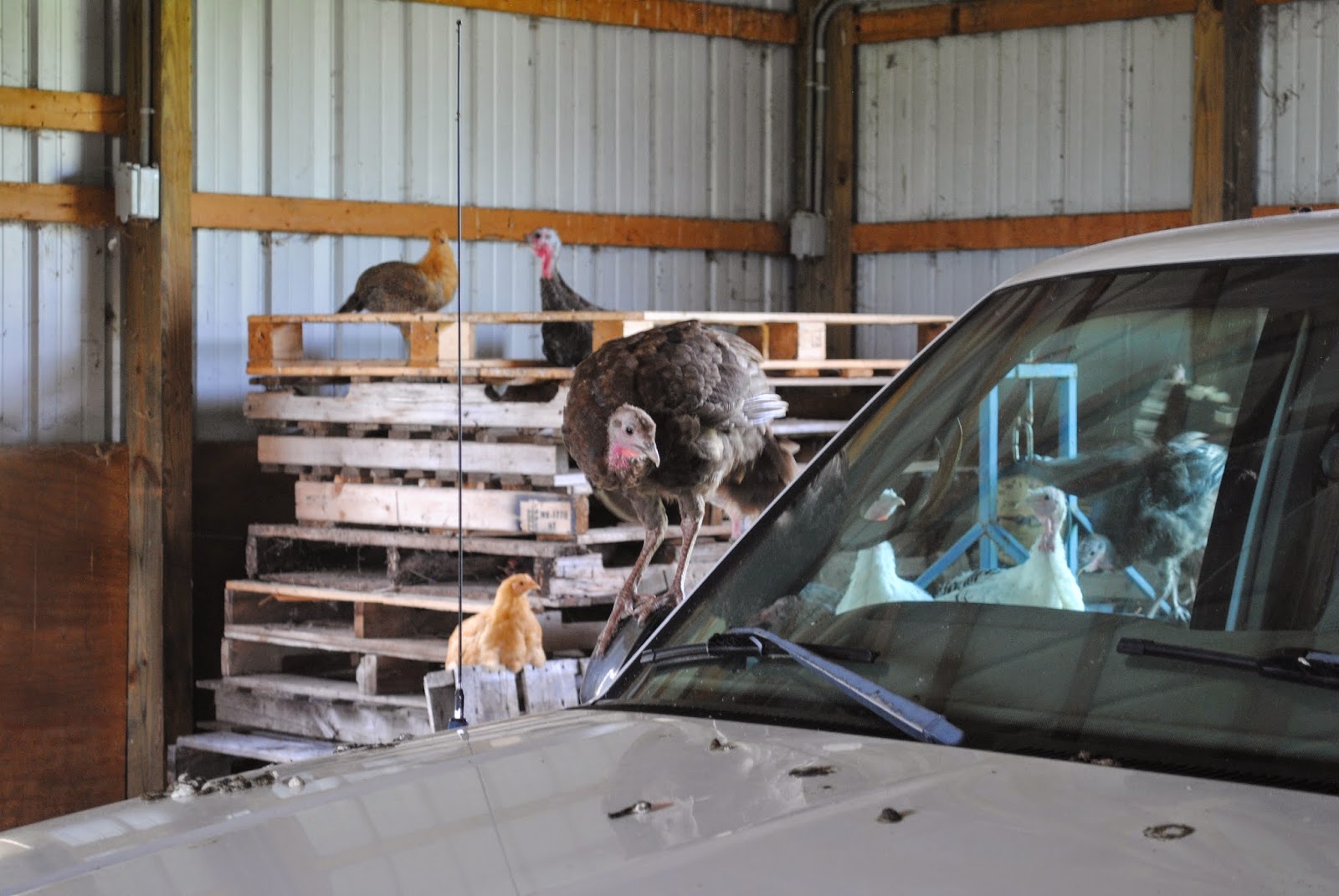
And the heritage turkeys are coming up in the world. The toms are just beginning to fan out and strut. Watching something the size of soccer ball strut is very endearing.

Edmund and Garth devoted a lot of time this summer to prepping the North half of our flat land for a fence. They spent weeks thinning this tree line and dealing with the abundance of wood and roughage that resulted.
The Soil and Water folks in our county have a post pounder they rent out at a price well below all of their competitors that we took advantage of. The engine stopped 5 minutes into the project, but two guys from their office came out and fixed it within an hour of our call. What service!
And the heritage turkeys are coming up in the world. The toms are just beginning to fan out and strut. Watching something the size of soccer ball strut is very endearing.
There is so much more to tell, but I will save it for another day.
- Alanna
Saturday, August 9, 2014
Bryn Athyn Bounty Saturday 16th: special cup offer!
On August 16th, we will be selling our meat at Bryn Athyn Bounty Market in Bryn Athyn, PA. We are really excited to provide our customers with healthy, delicious, humane grass-fed beef. This Saturday, we have something really special to offer in addition to our beef: handmade porcelain cups thrown by Normandy Alden and decorated with cobalt lines drawing by Alanna Rose. Our farm, these cups, this vision we have for our land and animals at Cairncrest Farm is truly a collaboration. These cups will be $50 at our table on Saturday, but FREE if you pre-order 100 lbs of meat or more. Email cairncrestfarm@gmail.com for information about pre-ordering. We are looking forward to seeing you on Saturday!


-Normandy
-
Friday, April 25, 2014
So Many New Faces

There are a few new faces around here. I heard that a grass based stocker operation near us (stockers are weaned beef cows that are sold to people who want more animals when the grass is abundant) had a number of steers available at a price below what people were paying at the auction. I thought it would be interesting to compare our new Kerry/Angus crosses with these pure-bred Angus cows through a growing season or two. After looking at their age and weight charts we decided on these two because they were middle of the road. One of them has a Simmental for a great-great grandfather, so even though he is Angus from every other side, he still wound up with a white face like his ancestor.


The biggest surprise was that a cow we didn't think was bred gave birth to a heifer calf. Sibley, who was herself the accidental product of an evening rendevous with her own father, had been small from the start and very slow growing. We attributed that to her onerously inbred genetics. She was the size of last years calves even though she had 8 or so months on them, and so we slated her for the slaughter house and fed her with the young stock over the winter. Low and behold, she too had gotten in with Mr. Winchester without our supervision and now we have a cow we didn't expect to. Not too shabby. It also changes Sibley's future here, at least in the short term. We are eager to see if her calf expresses unbridled hybrid vigor, coming from the combination of such a limited gene pool with a much broader and unfamiliar line.

The season began badly, but thankfully it wasn't a foreshadowing of things to come. Garth saw something strange hanging from the back of Acorn one evening. She wasn't having any contractions and the herd was not displaying the same anxious excitement that usually accompanies a birth. Garth took a photo and we called the vet. We sent him the image and he called us right back. He thought it looked like an unhealthy placenta and that we should go out and look for a dead calf. Garth scaled the pasture and finally found a dead heifer calf over the hill. Acorn was having trouble cleaning so we gave her some Caulophyllum in her water (a homeopathic remedy that is meant to encourage uterine contractions) and perhaps that helped. She seems fine now.
And now a great mystery has come to my attention. Garth tells me minutes ago that Butternut, last year's calf born here on 4/8/13, just gave birth to what looks like another heifer calf. That means that she was bred at 4 months old while she was still nursing under her own mother. We had been told that was impossible. What are the fertility gods doing around here? Her calf is up and nursing. This worries me though. We didn't separate the bull from the very young stock last year for the reason I mentioned above (it's not meant to be possible) and so what if all these babies have babies on us? Do they think it's some kind of animal farm over here? Oh my. I don't know what we are in for.
- Alanna
Friday, April 4, 2014
Thaw On
Although the world was white again on the morning of April first with a fresh inch on every surface, the sky was just playing us the fool. The thaw is officially ON.
 |
| Look, they are barely wearing coats. |
The well water to the farm house has greater allegiances with the stream than it does with our comfort or preference. As the stream goes, so goes the well. When the stream is churning brown, we pour tea colored baths. Cleaning the toilet doesn't offer the same satisfaction when dark water stares back at you. Judging from my view out the window, it should be clearing up soon.
And water isn't the only thing clearing out. We've seen several living examples that 'spring cleaning' is no cultural artifice. Everyone and everything has something to do away with this time of year. Garth mentioned to me a week or so ago that the field mice had simultaneously decided it was time to clean house. They broke through the icy crust and neatly piled the winter's poop at the snow's edge. Evacuation en masse. Hole after hole in the snow, each with it's own waste at the door. Even the soil is heaving unwanted contents up for the taking - bones, rocks, detritus, a civil war era medicine bottle. I joined the crowd by giving several ill-fitting shirts away.

Birds are making faint noises in the early morning now, too. I heard them a month ago on one occasion and then they fell silent as the last wave of cold nights swept in. But now two Robins are bouncing off the ground in a tryst with hoards of grackles looking on, covering the bare trees like leaves.

Maple sap is only just running. Mud creeps in between the cows' 'toes.' Bare earth lies everywhere. Spring, you have kept us waiting.


Thursday, February 27, 2014
Polar Vortex Returns
We, like many of you, felt the Polar Vortex lift off for a few days, only to return again in earnest. But the cold brings with it several benefits that you in the city or suburbs can't appreciate. The first is that freezing temperatures discourage the hatching of flies. We had only five consecutive days when the thermometer read above freezing - 43 being the highest it soared - and the effect on the latent in-house fly population was immediate. I decided to kill and then count the fly carcasses from just one average size window in this house (although I must admit it is in the running for most productive) and the results were unsavory. After just three warm days I had confirmation of more than 162 flies dead and stopped counting. That is just one window downstairs. We are not even talking about my upstairs studio. I get all crunchy inside, killing so many flies and witnessing the futility of my actions. I know there will be 50 more to contend with the next time I look. Arden, on the other hand, has just become sensitive to the miracle that flies are. She likes to reach and touch them as they walk up the living room window, and in a sharp twist of character I find myself assisting her - holding her up to see them, gently nudging them towards her open fingers. At least someone's enjoying them.

The few days of sustained warmth had other obvious effects here, namely the thaw en masse of vast amounts of accumulated snowfall. I was nursing Arden on the couch in the late afternoon when I heard something shift - a subtle elevation in white noise - and I looked behind me just in time to see this begin.

The stream had inches of ice on its surface which had been covered by around 18 inches of snow. I presume the wind helped this along by blowing more into the hollow of the stream bed. On one of the warmest days we sustained heavy rains and Garth and I were waiting to see what would come of it. We got our answer in the above image. An ice dam somewhere upstream must have cracked under the pressure and sent this dark and frothing 'frosty' hurling. I have never seen such a thing. It kept up for around an hour.

This is the aftermath. You can see where the water plowed the edges of the stream's snow bank.

And thankfully now the Polar Vortex has returned, which is no surprise to you, reading this, as you are, in your blanket and hat. It left long enough to give us a taste of what's to come, and I'd be lying if I said we didn't like it. But the upside is that the flies are less enthusiastic (although still coming by the handful daily). At the very least you now have proof that we don't spray for flies or use other insecticides, apart from our own hands.
Lastly, I am grateful that Garth takes Arden to do the afternoon chores, regardless of the Vortex's whereabouts. She doesn't complain, and if it is really blowing we do keep her in.


- Alanna
Subscribe to:
Posts (Atom)